
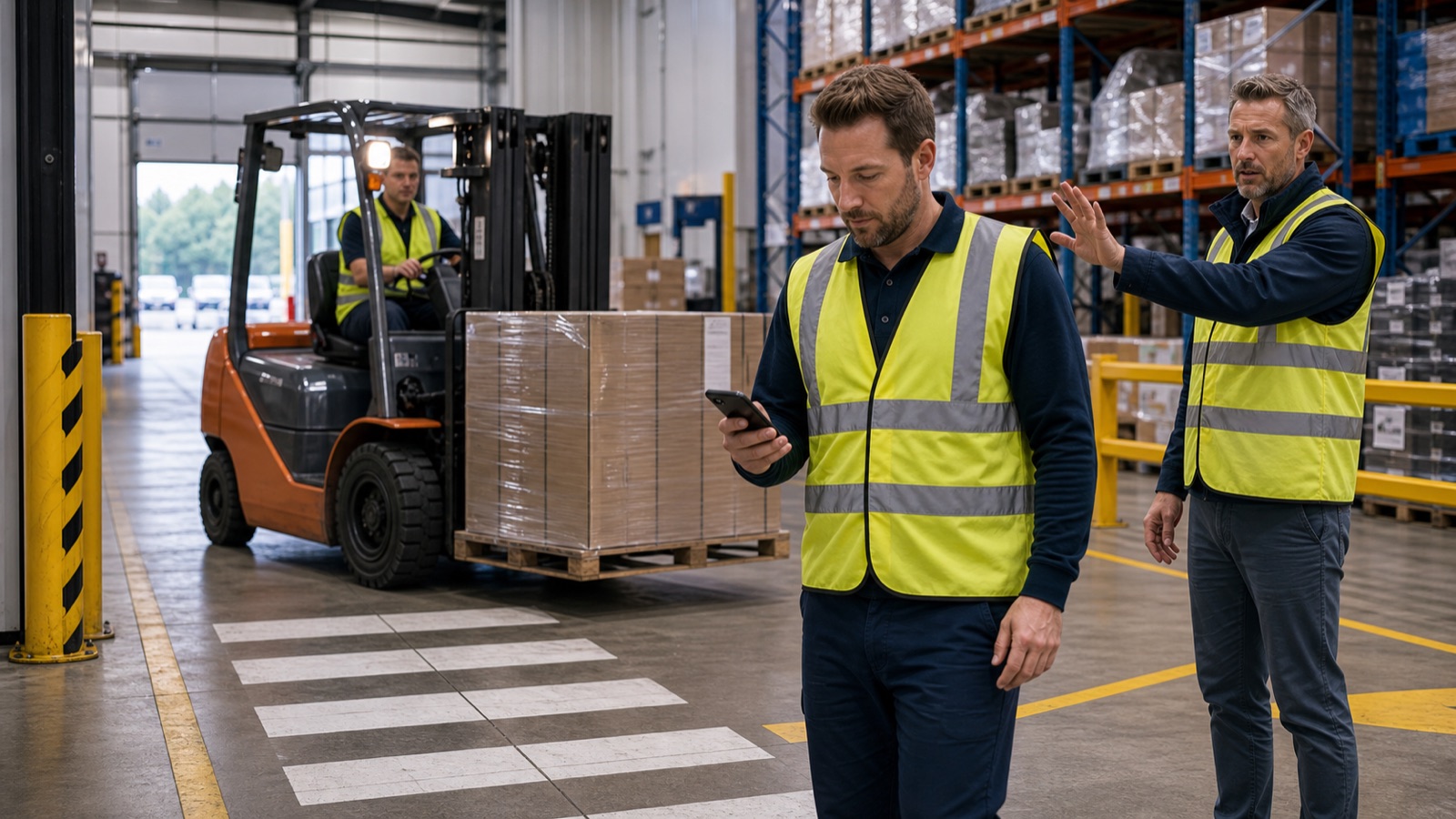
Understanding forklift site rules matters because it can change availability, safety, cost or compliance in a real forklift operation. This guide explains the practical point a manager needs before written rules look acceptable but fail in the places where pedestrians, trucks, time pressure and poor visibility actually meet.
Short answer
Forklift site rules means turning workplace transport expectations into controls people can actually follow during a busy shift. It should cover routes, pedestrians, speed, loading, parking, pre-use checks, reporting and supervision. For forklift site rules, the workplace-transport question is whether the control works around people, loads, layout and time pressure. For forklift site rules, a manager can move beyond theory by checking near-miss evidence linked to layout and workload, segregation maintained during temporary changes and whether delivery drivers entering truck routes unbriefed is present.
What this means in practice
Forklift site rules should be tested on the floor. If operators cannot follow the rule because the layout, workload or equipment makes it unrealistic, the document will not protect people or managers. For forklift site rules, the workplace-transport question is whether the control works around people, loads, layout and time pressure. Managers reviewing forklift site rules should be able to point to the observation, action and risk reduced. Reviewing forklift site rules, managers can ground this question at the loading-bay changeover when pedestrians and vehicles converge. For forklift site rules, they should observe the task during a normal busy period rather than an empty-site trial, record the decision, owner and review date beside the original evidence, and examine pre-use defects remaining only in verbal reports. Connect forklift site rules to the next operational choice and the evidence needed to defend it.
Weak forklift site rules can leave gaps between what the site says should happen and what happens around trucks, pedestrians, loading bays and shared routes. Turn the finding on forklift site rules into one named action and a review date instead of leaving several possible responses open.
Key checks
- For forklift site rules, walk the main routes at peak movement times. Record its effect on pedestrian exposure at shared crossings.
- Before approving a response to forklift site rules, check pedestrian crossings, blind corners, yard areas and loading bays. Connect the finding to housekeeping around wheels, thresholds and aisles.
- Using the loading-bay changeover when pedestrians and vehicles converge to test forklift site rules, confirm pre-use checks and defect reporting are acted on. Show whether it changes seat-belt and restraint use on ramps or yards.
- For forklift site rules, separate observation from assumption and review whether operators, visitors and delivery drivers understand the same rules. Use racking marks at a repeated impact point to judge its importance.
- For forklift site rules, the person approving the next step should assign owners for rule updates, training actions and physical changes. Record its effect on visitor and driver movement outside marked routes.
Common mistakes
For forklift site rules, a weak decision would treat one symptom as proof while overlooking near-miss evidence linked to layout and workload. Without evidence about temporary stock blocking designed visibility, the site cannot tell whether the same mechanism has returned.
What good looks like
For forklift site rules, a defensible target state combines consistent behaviour at the loading-bay changeover when pedestrians and vehicles converge, evidence of near-miss evidence linked to layout and workload, ownership of alarms ignored because they sound continuously and a documented review threshold.
When to ask WRMH for help
For forklift site rules, bring WRMH in if the site has recorded near misses clustered around one crossing but still cannot settle the action. Truck identity, task detail and segregation maintained during temporary changes allow a more accurate and commercially controlled response.