
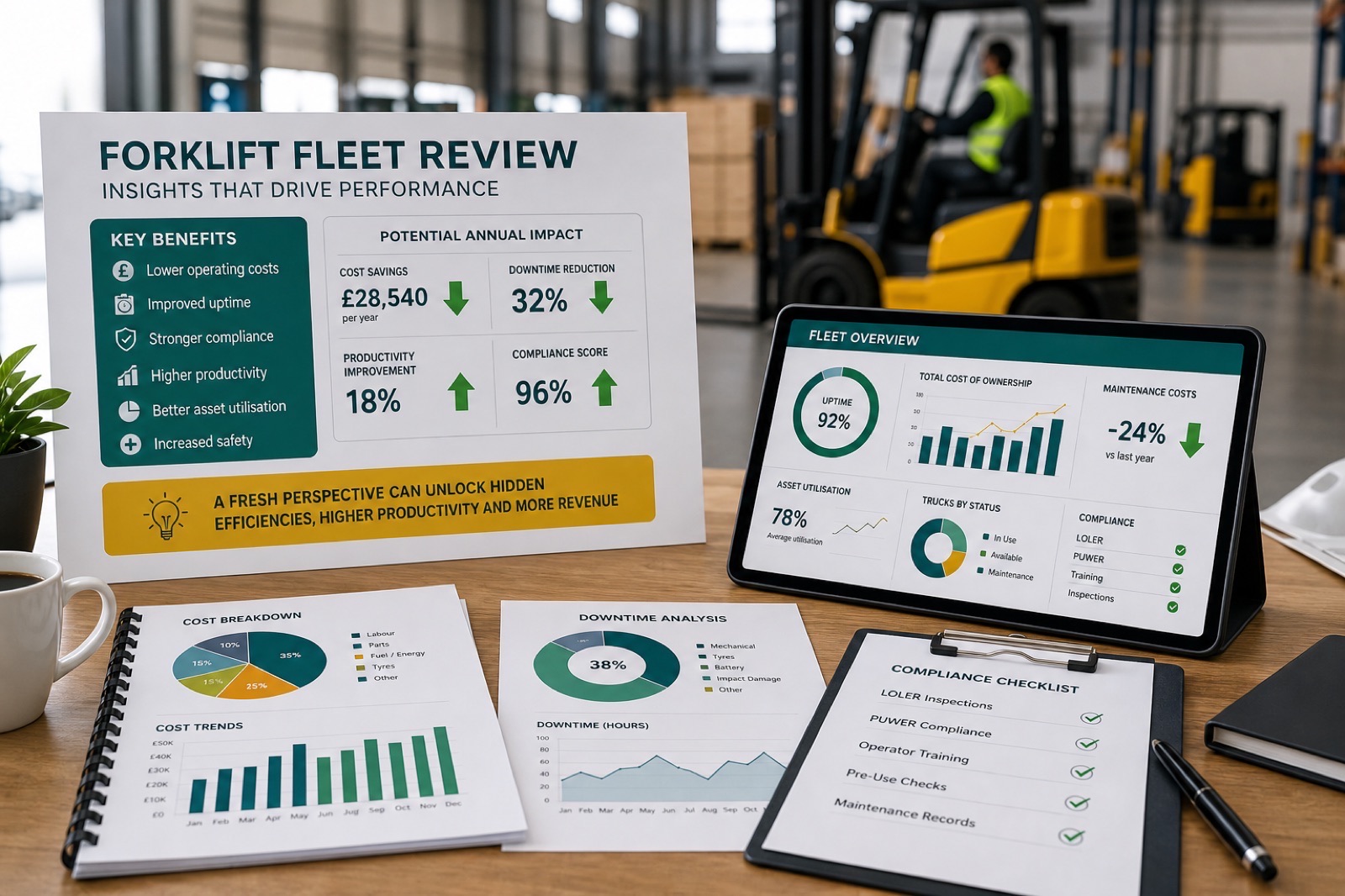
Understanding how to review mixed fleet costs matters because it can change availability, safety, cost or compliance in a real forklift operation. This guide explains the practical point a manager needs before forklift cost is reviewed as invoices rather than as a pattern created by utilisation, damage, downtime, tyres, batteries, hire and maintenance behaviour.
Short answer
Review mixed fleet costs means finding where forklift spend is created, wasted or protected across trucks, people, routes and support decisions. For review mixed fleet costs, the cost question is whether avoidable spend, downtime, hire dependency or replacement pressure is being created. For review mixed fleet costs, this becomes a management decision once hire dependency beyond planned cover, whole-life cost rather than the latest invoice and hire extensions hiding an unresolved repair have been checked together.
What this means in practice
Review mixed fleet costs becomes useful when invoices are linked to operational causes. Tyres, batteries, callouts, damage, hire extensions and underused trucks all tell a manager something about how the fleet is working. For review mixed fleet costs, the cost question is whether avoidable spend, downtime, hire dependency or replacement pressure is being created. Managers reviewing review mixed fleet costs should be able to point to the observation, action and risk reduced. Reviewing review mixed fleet costs, a live-site check of review mixed fleet costs should centre on the review of repeat damage by truck, route and shift. For review mixed fleet costs, first put a cost or delay against the event before ranking the response; next photograph the condition and record when it appears. For review mixed fleet costs, the method is complete when the observation, decision, action and confirmation are all visible. Use overtime following truck availability losses as corroborating evidence.
If cost is reviewed only as separate invoices, the business may keep paying for the same pattern without fixing the cause. For review mixed fleet costs, use that evidence to choose between continued operation, monitoring, repair, training, inspection, hire cover or an equipment change.
Key checks
- To assess review mixed fleet costs, review spend by truck, not only total spend. Record its effect on tyre spend against surface and turning conditions.
- Before review mixed fleet costs consumes time or budget, look at downtime and hire cover together. Use utilisation during peak and ordinary weeks to judge its importance.
- At the review of repeat damage by truck, route and shift, for review mixed fleet costs, check damage, tyre, battery and repair patterns. Show whether it changes repeat damage by truck, route and shift.
- To make review mixed fleet costs site-specific, compare utilisation against fleet size and peak demand. Connect the finding to repair cost against replacement timing.
- Before the review mixed fleet costs action is closed, choose the first cost pattern to fix and assign an owner. Record its effect on unplanned downtime by individual asset.
Common mistakes
For review mixed fleet costs, a quick response can be the wrong response if it bypasses hire dependency beyond planned cover. Managers also need battery life falling below the budget assumption recorded, otherwise recurrence cannot be recognised with confidence.
What good looks like
For review mixed fleet costs, at the review of repeat damage by truck, route and shift, good control means the observation, owner, action threshold and follow-up result are visible. Evidence covers hire dependency beyond planned cover and replacement delayed while repair spend accelerates; the manager can explain the response and its review trigger.
When to ask WRMH for help
For review mixed fleet costs, ask for WRMH support when the decision about review mixed fleet costs depends on specialist interpretation of whole-life cost rather than the latest invoice. Evidence from the review of repeat damage by truck, route and shift, including missed pallet movements during the shift peak, helps target the right repair, parts, training, inspection, hire or equipment response.