
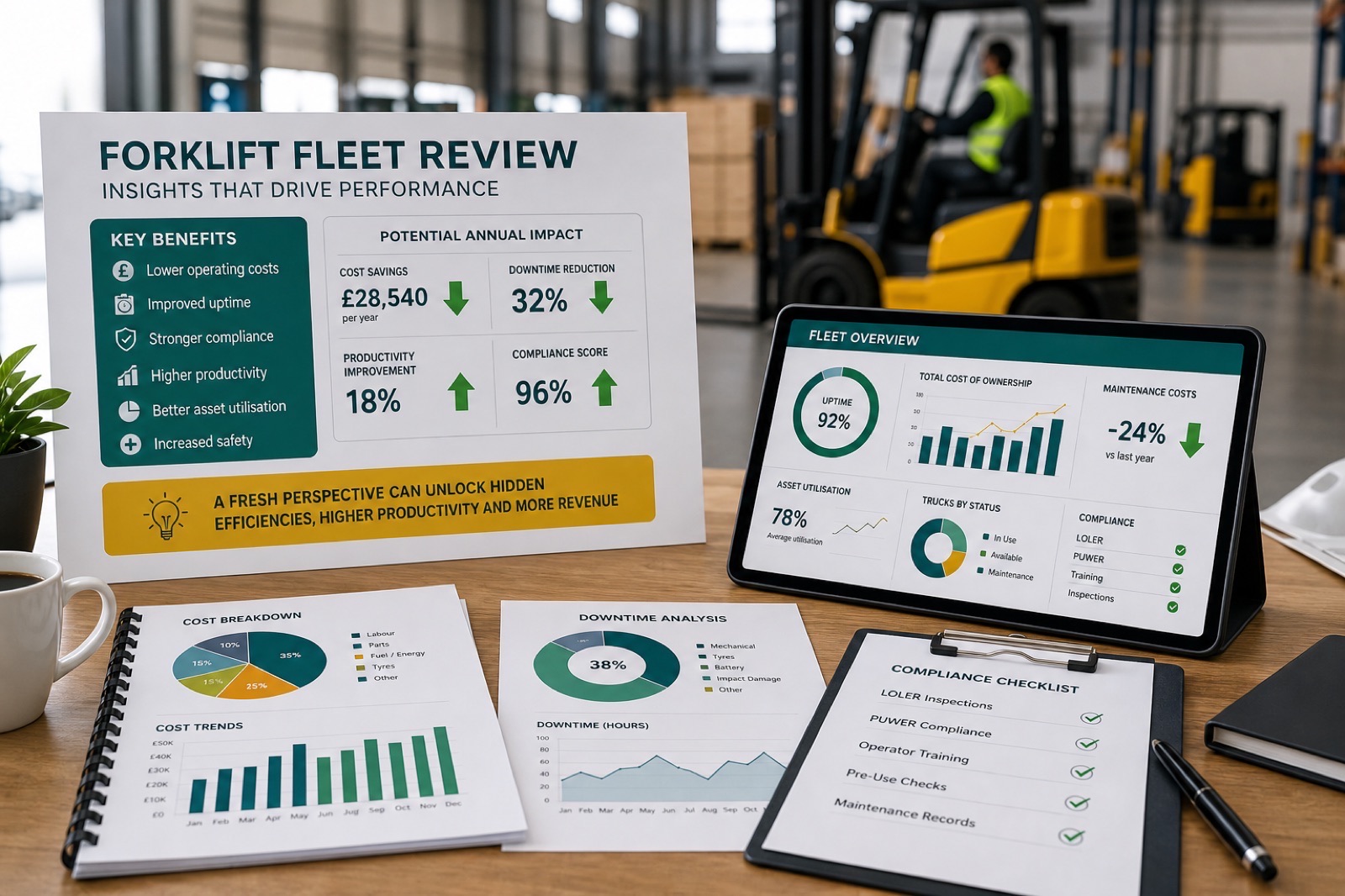
Understanding forklift whole-life cost matters because it can change availability, safety, cost or compliance in a real forklift operation. This guide explains the practical point a manager needs before forklift cost is reviewed as invoices rather than as a pattern created by utilisation, damage, downtime, tyres, batteries, hire and maintenance behaviour.
Short answer
Forklift whole-life cost is a commercial equipment decision: how to get the right forklift capability without tying up more cash, risk or support burden than the operation needs. For forklift whole-life cost, the cost question is whether avoidable spend, downtime, hire dependency or replacement pressure is being created. For forklift whole-life cost, a manager can move beyond theory by checking battery replacement against charging behaviour, hire dependency beyond planned cover and whether hire extensions hiding an unresolved repair is present.
What this means in practice
Forklift whole-life cost should be judged against hours, criticality, support cover, warranty, maintenance, residual value and the cost of the truck being unavailable. With forklift whole-life cost, the cheapest route can be expensive if it leaves the site exposed. For forklift whole-life cost, the cost question is whether avoidable spend, downtime, hire dependency or replacement pressure is being created. Managers reviewing forklift whole-life cost should be able to point to the observation, action and risk reduced. Reviewing forklift whole-life cost, managers can ground this question at the decision point between another repair and planned replacement. For forklift whole-life cost, they should check whether another truck doing the same task shows the same pattern, compare the latest observation with the previous three records, and examine utilisation evidence showing idle capacity. Connect forklift whole-life cost to the next operational choice and the evidence needed to defend it.
A weak decision on forklift whole-life cost can lock in the wrong truck, hide maintenance cost, consume capital unnecessarily or make replacement harder. Turn the finding on forklift whole-life cost into one named action and a review date instead of leaving several possible responses open.
Key checks
- For forklift whole-life cost, define the job before comparing prices. Record its effect on overtime created by delayed pallet movement.
- Before approving a response to forklift whole-life cost, compare new, used, hire, lease and purchase as operating routes, not only payment routes. Connect the finding to hire dependency beyond planned cover.
- Using the decision point between another repair and planned replacement to test forklift whole-life cost, check maintenance, warranty, LOLER and hire-cover assumptions. Show whether it changes customer credits linked to handling damage.
- For forklift whole-life cost, separate observation from assumption and confirm operator training and site suitability. Use battery replacement against charging behaviour to judge its importance.
- For forklift whole-life cost, the person approving the next step should set a review point for replacement or contract change. Record its effect on maintenance cost per operating hour.
Common mistakes
For forklift whole-life cost, a weak decision would treat one symptom as proof while overlooking battery replacement against charging behaviour. Without evidence about unplanned minutes lost before the load moves, the site cannot tell whether the same mechanism has returned.
What good looks like
For forklift whole-life cost, the target state is a shared rule at the decision point between another repair and planned replacement, supported by evidence about battery replacement against charging behaviour, a named owner and records addressing maintenance cost per operating hour.
When to ask WRMH for help
For forklift whole-life cost, bring WRMH in if the site has recorded missed pallet movements during the shift peak but still cannot settle the action. Truck identity, task detail and hire dependency beyond planned cover allow a more accurate and commercially controlled response.
Deeper WRMH view
A longer read is useful here because forklift whole-life cost can affect more than one part of the operation. Managers may start with one symptom, but the answer often sits across truck suitability, operator behaviour, records, parts, servicing, hire cover or replacement planning.
The most useful approach is to connect the subject to the site reality. That means asking where the truck works, who uses it, what load it carries, what records exist and what happens to the operation if the issue is not controlled.
What managers should look for
Look for evidence that changes the decision, not just evidence that confirms there is a problem. Repair history, defect notes, operator comments, inspection reports, usage hours, hire records and damage patterns can all point to a better next step.
- For forklift whole-life cost, define the job before comparing prices. Record its effect on overtime created by delayed pallet movement.
- Before approving a response to forklift whole-life cost, compare new, used, hire, lease and purchase as operating routes, not only payment routes. Connect the finding to hire dependency beyond planned cover.
- Using the decision point between another repair and planned replacement to test forklift whole-life cost, check maintenance, warranty, LOLER and hire-cover assumptions. Show whether it changes customer credits linked to handling damage.
- For forklift whole-life cost, separate observation from assumption and confirm operator training and site suitability. Use battery replacement against charging behaviour to judge its importance.
- For forklift whole-life cost, the person approving the next step should set a review point for replacement or contract change. Record its effect on maintenance cost per operating hour.
Why the decision matters commercially
Forklift issues often create cost indirectly. A truck that is wrong for the route slows people down. A training gap creates damage. A missed inspection creates uncertainty. A poor parts decision delays a first-time fix. A weak sourcing route can tie up capital without improving uptime.
The stronger decision is the one that gives managers more control: clear equipment suitability, clear records, clear operator competence and a practical route if the truck is unavailable.
Practical next step
If forklift whole-life cost is starting to affect a live operation, ask WRMH to help turn the issue into a practical action. Share the truck details, site conditions, usage pattern and the business impact, and WRMH can help decide whether the next step should be repair, hire, parts, training, LOLER planning, equipment advice or a wider fleet review.