
The problem
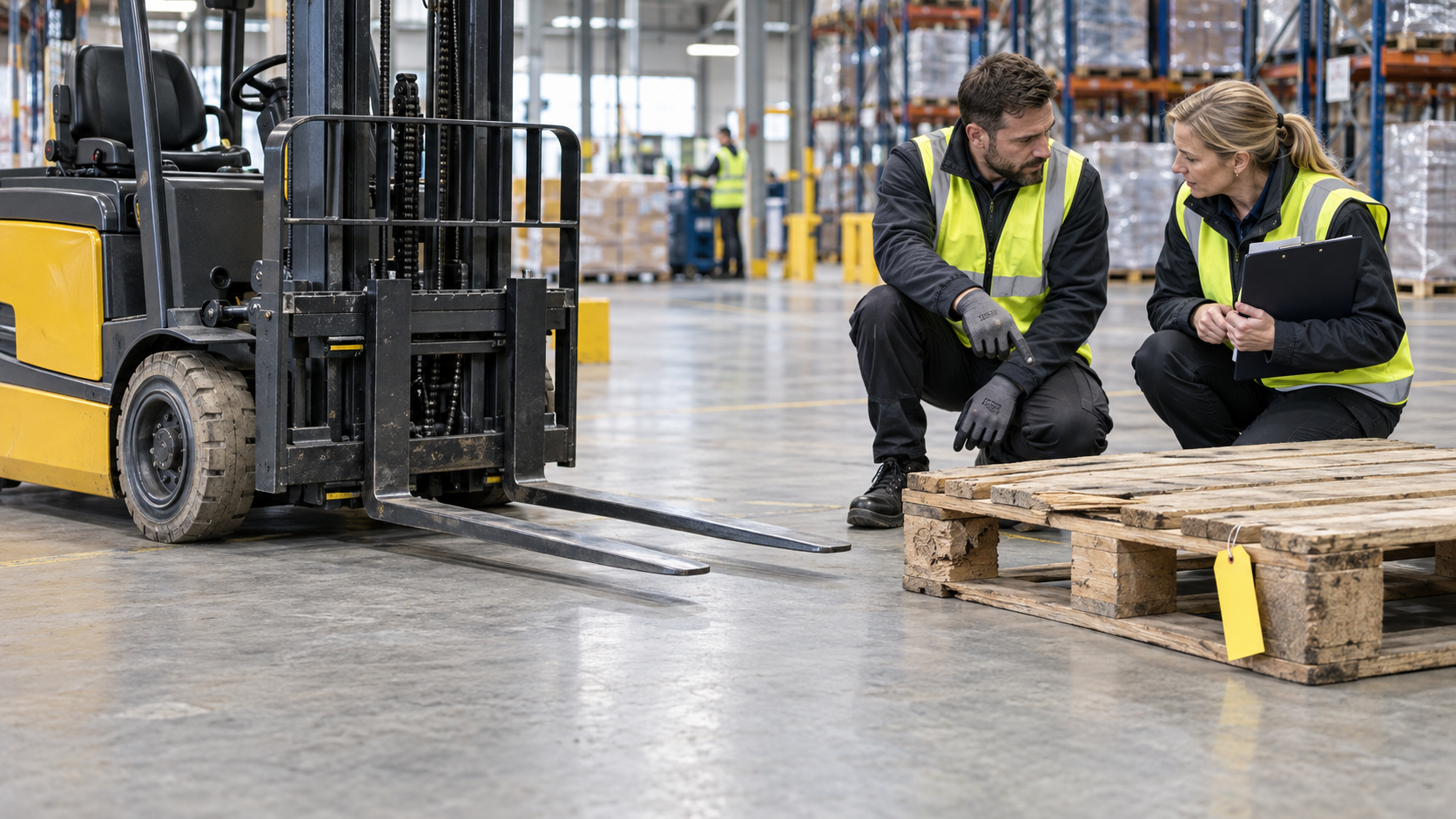
Poor pallet handling often starts before the truck moves. An operator finds a split block, loose board, protruding nail, collapsed entry or load sitting off-centre, but the shift still needs the pallet moved. Without a clear rejection standard, the operator may try to square it with the fork tips, lift from a weak entry or carry a load whose support can change as soon as it leaves the floor.
The operational consequence becomes clear at the point of despatch. For example, a food distribution warehouse is loading a time-sensitive retailer order with an electric counterbalance. The operator sees that one bottom block has split, but the replacement pallet station is across the building and the carrier is already on the bay. When the forks enter, the damaged block shifts, the wrapped load leans and the movement is stopped; product must be restacked, the truck is held for a fork check and the trailer misses its planned loading sequence. This proves the main point: the cost was created by an unclear accept-or-reject decision before the lift, not simply by how the operator drove afterwards.
If the issue is left unmanaged, operators develop different personal thresholds. One rejects a cracked board, another uses sideshift to correct a poor entry and a third asks a colleague to steady the load. Product damage, fork-tip wear and pallet failures are then recorded separately, making the shared cause difficult to see. Managers need to decide which defects always stop movement, who authorises repalletising and how rejected pallets are recorded so supplier quality, operator competence and equipment condition can be reviewed on evidence.
How WRMH could help
WRMH can help managers review the pallet, handling task and truck together. Fork tips, heels, carriage alignment and attachment faces can be inspected for the physical pattern left by repeated poor engagement, while operator observation shows whether the difficulty begins with technique, pallet condition, load presentation or pressure to keep the movement going.
The first sensible step is to observe the busiest pallet handover and build a short acceptance standard from what operators actually encounter. Record split or missing blocks, broken lead boards, exposed fixings, blocked fork entries, unstable wrapping, overhang and incompatible pallet dimensions; then define stop, quarantine, repalletise and supervisor-escalation decisions. WRMH can use that evidence to shape task-specific coaching and check whether recurring fork, carriage or attachment wear supports the same conclusion.
This gives supervisors a more defensible decision than asking operators to use judgement without boundaries. Clear acceptance evidence improves confidence, separates pallet-supply problems from competence gaps and reduces the chance that another forced lift becomes fork damage, product loss or unplanned downtime.
Common mistakes
A common mistake is writing “do not use damaged pallets” into a procedure without showing operators what that means at the fork entry. A split deck board, crushed block, protruding nail, wet timber, load overhang and an incompatible four-way entry do not create the same decision. Another mistake is recording only the damaged product after a failed movement, which loses the pallet condition, supplier, truck and operator evidence needed to prevent a repeat.
When to ask WRMH for help
Ask WRMH for help when split pallets, poor fork entry, product restacking or repeated fork and carriage damage suggest that pallet acceptance is inconsistent. WRMH can inspect the contact and wear pattern on the equipment, observe the actual load engagement task and focus operator development on the decisions that occur before lifting. Managers gain clearer evidence for training, pallet-supplier conversations and equipment repairs, with less risk of paying for another damaged component while the same unsuitable pallets continue through the operation.
Helpful next step: Choose one high-volume pallet movement and agree the visible defects that mean stop, quarantine and escalate before the forks enter.
Further reading
Build your understanding of this topic
These related knowledge base articles give you more context, checks and practical language before you decide what to do next.