The problem
Racking damage is often treated as a facilities repair followed by a reminder to drive carefully. That response can restore the upright or rack-end protector without addressing why contact was likely. Repeated scrapes, displaced guards and bent lower bracing can be evidence that replenishment timing, pallet staging, aisle clearance, truck geometry and supervision are working against one another.
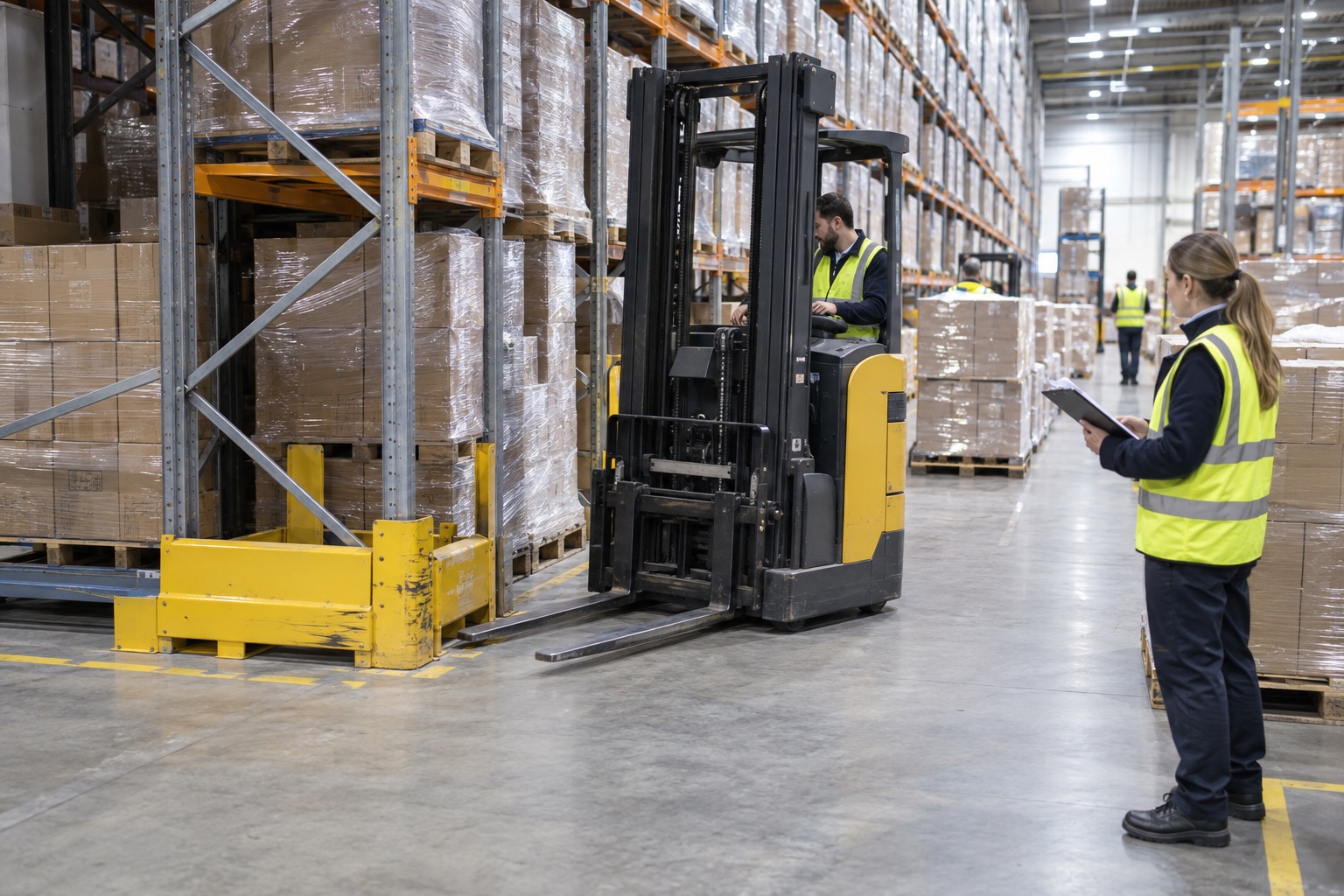
The operational pressure becomes visible at the rack end. For example, a food distribution warehouse uses a reach truck to replenish fast-moving stock before the afternoon despatch wave. Two outbound pallets are staged beyond their marked area, narrowing the turn into the aisle just as replenishment has to accelerate. The truck clips a rack-end protector, the aisle is isolated for inspection and picking loses access to three bays while the carrier window approaches. This proves the main point: the contact involved an operator, but the lost clearance, timing and staging decision helped create the event.
If that pattern is left unmanaged, the site can keep paying for rack inspections, replacement guards, truck panels and disrupted picking while the same turn remains difficult. Informal workarounds may then become normal: operators approach at a sharper angle, use more steering lock at low speed or wait for gaps that delay replenishment. Managers must decide whether the evidence supports coaching, a staging change, traffic timing, protection work or a more suitable truck.
How WRMH could help
WRMH can help managers review the truck and the movement around the damaged location rather than treating the rack and forklift as separate problems. Equipment condition, steering and tyre behaviour can be checked alongside truck dimensions, load presentation, operator competence and the working clearance available when the aisle is genuinely busy.
The first sensible step is to preserve the evidence before the area returns to normal. Record the exact rack position, truck, load, operator, shift and task; photograph contact heights and tyre marks; measure the usable turn with normal staged stock present; and compare the event with previous rack and truck repairs. WRMH can then help distinguish an equipment defect or suitability constraint from a technique, supervision or workflow issue.
The result is a decision that can be defended across operations, safety and finance. Managers gain clearer control of rack repair cost, truck availability and aisle productivity because the intervention is tied to the movement that created the damage, with evidence to show whether it worked.
Common mistakes
A common mistake is closing the event when the rack has been inspected and the damaged guard has been replaced. That confirms whether the structure can return to use, but it does not explain the contact. Another is blaming the nearest operator without comparing pallet staging, actual turning clearance, peak-time traffic and whether the truck or attachment projects differently from the equipment the aisle was designed around.
When to ask WRMH for help
Ask WRMH for help when rack contact repeats at one bay or turn, truck damage mirrors the rack marks, or managers cannot tell whether training, maintenance, equipment specification or workflow should change first. WRMH can inspect the truck, interpret tyre and impact evidence, compare its dimensions and steering behaviour with the live route, and support task-specific operator development where the evidence points there. This gives the site a more reliable prevention decision before another repair or blocked aisle affects uptime.
Helpful next step: Review the next racking repair as an operating-pattern decision, not only a facilities job.
Further reading
Build your understanding of this topic
These related knowledge base articles give you more context, checks and practical language before you decide what to do next.