
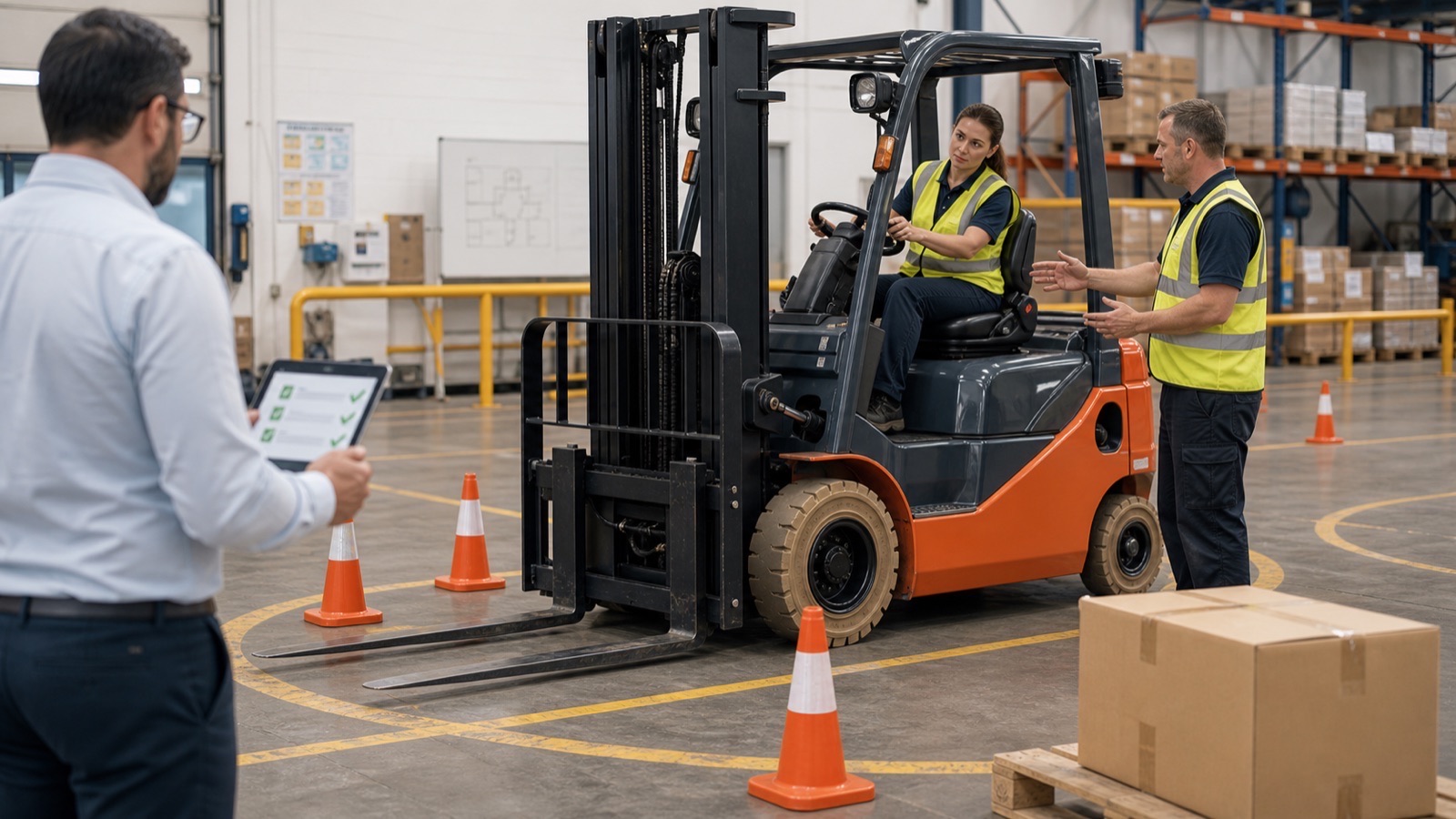
Repeatedly selecting reverse while a forklift is still moving forwards transfers a routine handling shortcut into the transmission, drive motor, tyres and load. The truck may appear to tolerate it for months, while repair history gradually fills with shock-related wear that no single incident explains.
Short answer
Changing direction before the forklift stops creates an abrupt opposing force through the drive system. Operators should bring the truck to a controlled stop before selecting the opposite direction, unless the manufacturer has provided a specific controlled feature and the site has confirmed how it should be used. Repeated jolts, load movement and tyre scrub justify observation before another repair is approved.
What this means in practice
In a packaging warehouse, an electric counterbalance shuttles pallets between a wrapper and dispatch lane. During a queue, one operator selects reverse while the truck is still rolling forwards to save a second on each cycle. Pallets rock against the backrest and the truck develops a pronounced driveline jolt. The immediate pressure is throughput; the later consequences are product movement, tyre wear and an intermittent drive complaint.
The manager must decide whether the behaviour is an individual competence issue, a normalised team habit, an unrealistic cycle expectation or confusion about an automatic braking feature. Observe the same task across operators and trucks before assuming the component failed independently.
Key checks
- Watch the truck's wheels and travel direction at the exact moment the selector changes.
- Compare driveline jolts and load movement between operators on the same task.
- Check whether damage or faults cluster around high-frequency shuttle work.
- Confirm the manufacturer's intended use of regenerative braking or direction controls.
- Review whether cycle targets reward continuous shuttling without a controlled stop.
Repair notes can help separate the causes. A direction-change habit may be accompanied by repeated tyre scrub, mounting wear, drive faults or operator reports of a harsh take-up. A single symptom is not proof; the value comes from matching technical findings with an observed movement.
Common mistakes
Telling operators to be gentler without demonstrating the stop-and-select sequence leaves the standard open to interpretation. Another mistake is applying the same rule to every truck without checking whether its control system has manufacturer-defined braking behaviour that operators need to understand.
What good looks like
Operators demonstrate a controlled stop before direction selection on the real shuttle task, supervisors know what movement to observe, and drive complaints are linked to the operating context. Cycle measures allow the correct sequence, and managers can explain whether any exception is supported by the truck's operating instructions and site familiarisation.
When to ask WRMH for help
Ask WRMH when a truck develops recurring drive jolts, tyre wear or mounting damage and the repair history does not identify a single fault. WRMH can inspect the drive system, compare the symptoms with the task and provide targeted operator training. That gives managers faster diagnosis and evidence for whether repair, coaching or a workflow adjustment will prevent repeat downtime.
Helpful next step: observe twenty direction changes on the highest-frequency shuttle task and record whether the wheels stop before the selector changes.