
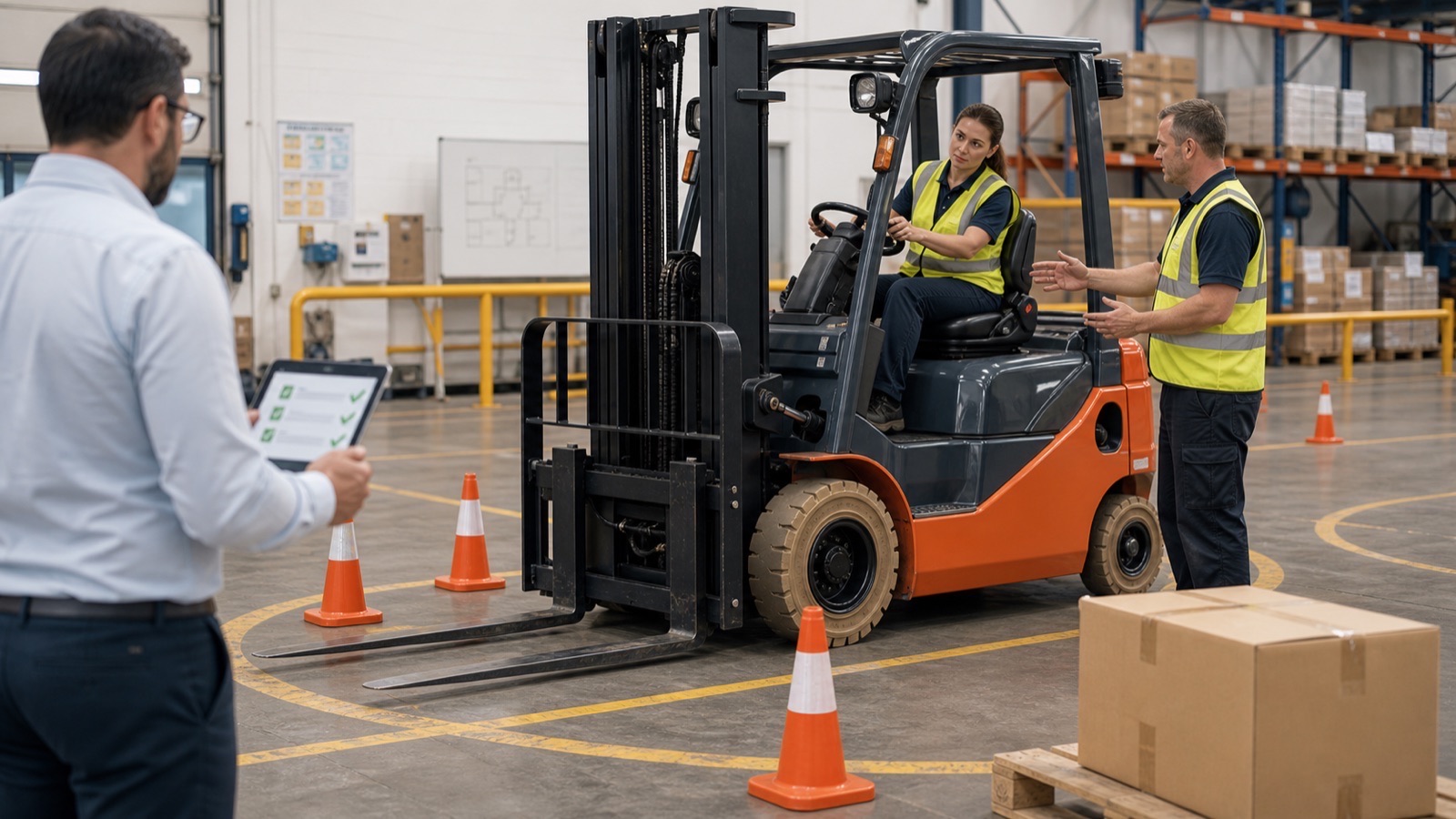
A damage incident does not automatically prove that an operator has lost competence, but returning them immediately without reviewing the event can leave the same decision, unfamiliarity or site pressure unchanged. Reauthorisation should be proportionate to what the evidence shows.
Short answer
Reauthorise an operator after confirming the incident cause, truck condition and competence needed for the affected task. The route back may be a documented conversation, site familiarisation, observed task, formal reassessment or refresher training. Managers should state who made the decision, what the operator demonstrated and any temporary restriction.
What this means in practice
A counterbalance operator clips a loading-bay post while reversing a tall load. Investigation finds the reversing camera was obscured, but the operator also missed the site's required stop point. Repairing the camera alone ignores the task decision; sending the operator on a full novice course ignores existing competence. A focused observation after the camera is restored can test the relevant behaviour.
The manager decides whether the incident arose from knowledge, skill, deliberate departure, unfamiliar equipment or an environment the operator could not reasonably control. Serious risk may justify suspension pending competent assessment; lower-level events still require recorded reasoning.
Key checks
- Confirm the truck is safe and technical defects are separated from operator evidence.
- Record the task, route, load, decision and site conditions involved.
- Check certificates, authorisation and familiarisation for that truck and attachment.
- Define the exact behaviour or competence the operator must demonstrate.
- Record the assessor, outcome, restrictions and follow-up observation date.
Reauthorisation is an operational control, not only a disciplinary outcome. Similar events involving several operators should trigger a wider route, workload or equipment review rather than repeated individual restrictions.
Where restrictions are temporary, state their scope and expiry clearly. An operator authorised for open-yard movements but not the incident task should not be described simply as “cleared”, because supervisors need an allocation decision they can apply.
Common mistakes
Using a fixed suspension period without assessing competence provides no evidence that the operator can perform the task. The opposite error is relying on an apology or clean certificate while skipping practical observation of the incident movement.
What good looks like
The cause review, technical status and competence decision are linked. Operators understand any restriction and demonstrate the affected task before full authorisation returns. Supervisors can access the record and complete follow-up observation. Managers can explain why the response was proportionate and what evidence supported return to work.
When to ask WRMH for help
Ask WRMH when the event raises a genuine competence question or the correct route between familiarisation, reassessment and training is unclear. WRMH can provide a task-relevant assessment and training evidence while considering the truck involved. That supports safer reauthorisation without assuming every incident requires the same course.
define the one task the operator must demonstrate safely before deciding the return-to-authorisation route.