
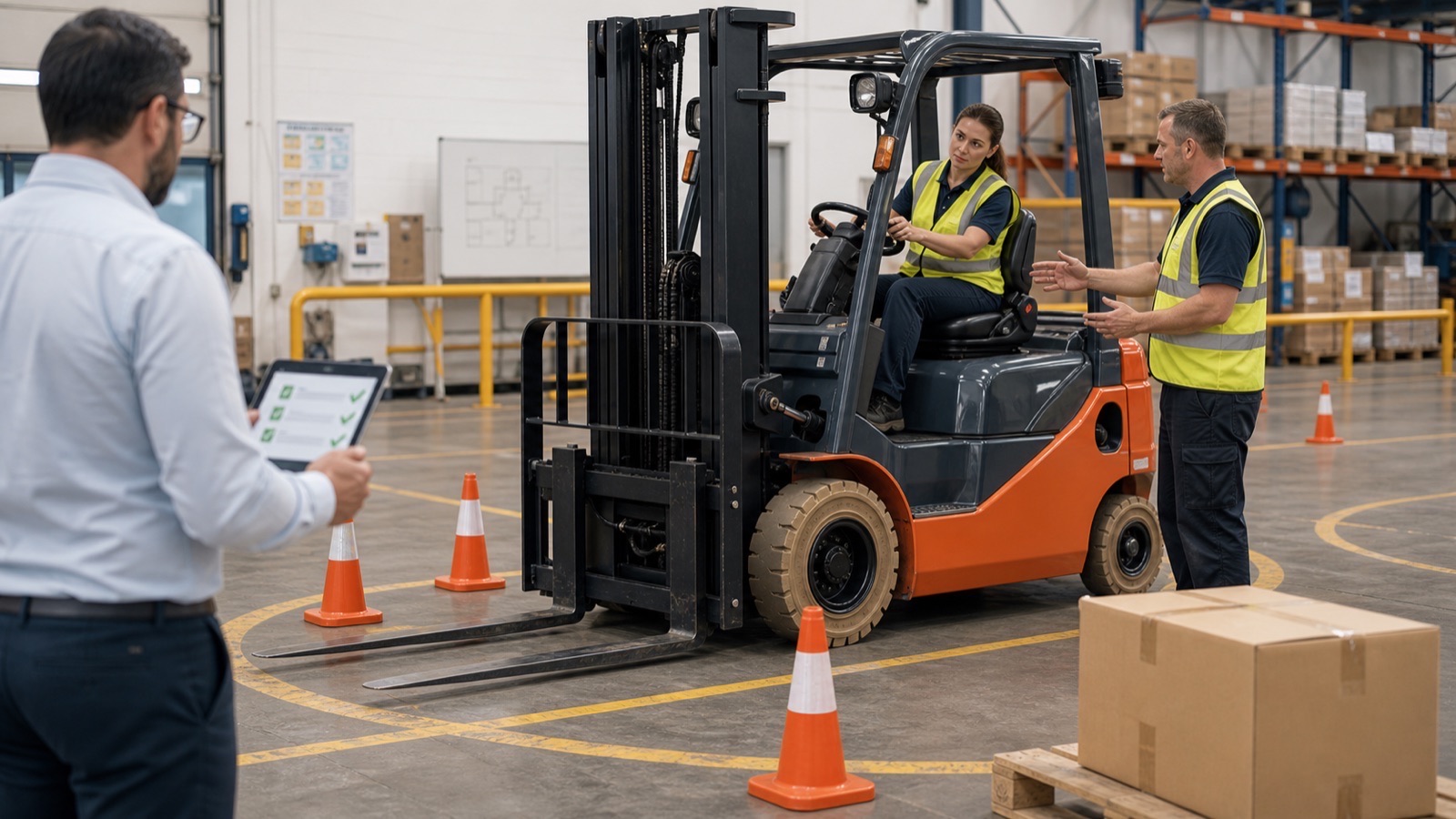
Another repair invoice does not automatically prove a training need. Investment is justified when evidence shows an addressable competence or behaviour gap, the affected task is understood and the chosen training response is more likely to prevent recurrence than repair alone.
Short answer
Recurring forklift damage should trigger training investment when incidents follow an operator group, technique or unfamiliar task after equipment condition and layout have been checked. Managers should choose between immediate coaching, site familiarisation, reassessment, conversion or refresher training according to the evidence. Generic refresher training is poor value when the truck or route is unsuitable.
What this means in practice
A drinks warehouse replaces fork-positioner hoses twice after operators repeatedly enter drive-in racking while still adjusting the attachment. Observation shows three operators using the same shortcut during peak replenishment. The repair restores the hose; task-specific training and supervision address the timing and approach that expose it.
The manager should compare damage frequency, repair and downtime cost with the group exposed to the task and the expected training outcome. Agree what behaviour must change and how it will be observed afterwards.
Key checks
- Identify whether damage follows an operator, team, task, truck or location.
- Confirm the equipment is serviceable and suitable before attributing the cause to competence.
- Match the observed gap to coaching, familiarisation, reassessment or formal training.
- Include repair cost, lost hours and product damage in the investment comparison.
- Set a follow-up observation and damage-rate measure for the affected task.
Training value should be judged against operating exposure. One event across thousands of well-controlled movements may need investigation without a fleet-wide course. A repeated technique across several shifts can justify a targeted programme even before the repair bill becomes large.
Cost the intervention around the people and task actually exposed. Releasing an entire fleet team for generic training can cost more and disrupt more work than a focused assessment followed by coaching for the operators who demonstrate the gap.
Common mistakes
Booking the same refresher course for everyone may satisfy an action list without addressing the damaging task. Another mistake is waiting for a serious collision when low-value repeated repairs already show a stable behaviour pattern.
What good looks like
The training decision cites observed behaviour, affected operators, truck and task. The intervention teaches and assesses that issue, supervisors reinforce it, and follow-up records compare equivalent workload and damage. Managers can explain why training was chosen instead of repair-only, layout or specification action.
When to ask WRMH for help
Ask WRMH when damage suggests a competence gap but the correct training route is unclear. WRMH can inspect the task evidence, distinguish familiarisation from reassessment or refresher need and deliver training around the relevant truck and load. That strengthens competence records and reduces the risk of paying for a course that does not address the cause.
write the exact observable behaviour the intervention must change before requesting a course.