
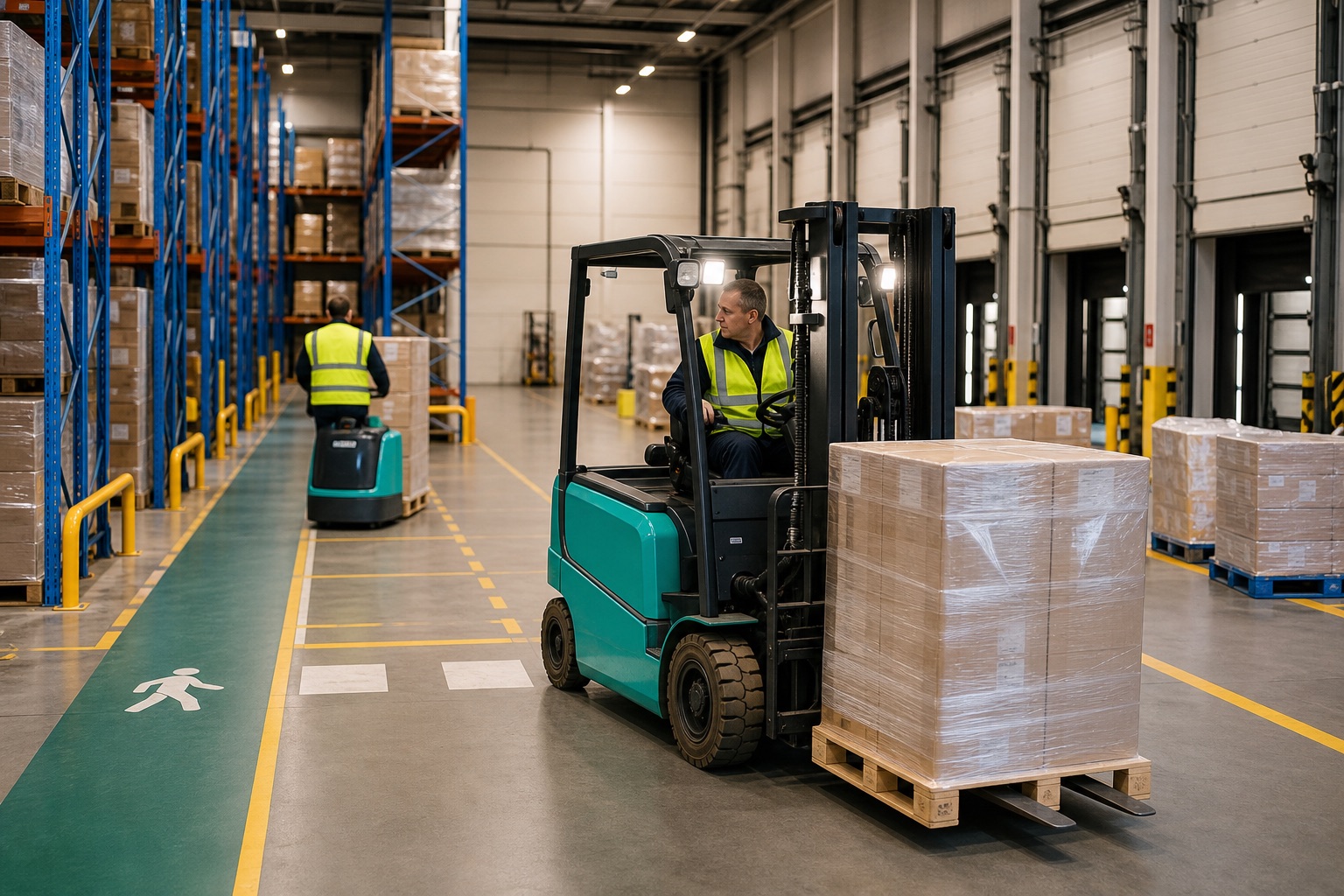
Fragile finished goods can be damaged without a visible collision. Uneven fork support, excessive clamp force, sudden tilt, pallet flex and repeated rehandling can create cracks, edge damage or cosmetic marks discovered only when the customer opens the load.
Short answer
Protect fragile finished goods by defining the approved pallet, fork spacing, support points, attachment settings, travel route and maximum rehandling for each load family. Managers should use damage position and handling trials to set limits. “Handle with care” is not a usable standard when operators face different products and packaging.
What this means in practice
A glazing manufacturer ships framed units on long stillages. Damage appears as corner cracks after delivery, despite intact wrapping. Observation shows narrow fork spacing allows the stillage to flex during a tight yard turn. Widening support within the approved pockets and reducing unnecessary transfers addresses the physical cause while preserving delivery flow.
The manager decides whether pallet or stillage design, attachment, truck specification, route, packaging or operator method should change. Trial the highest-risk product, not only the standard load.
Key checks
- Map cracks, dents and cosmetic marks to load support and contact points.
- Confirm pallet or stillage condition, fork pockets and approved spacing.
- Record clamp pressure, tilt, travel surface and number of transfers where relevant.
- Observe load flex and movement through the most demanding turn or transition.
- Retain final-condition evidence for customer-ready loads.
Handling standards should state measurable conditions and exceptions. If a damaged stillage removes safe support, quarantine it rather than asking an experienced operator to compensate.
Include sales and quality teams when defining acceptable condition. Cosmetic marks that do not affect structural safety may still make a premium finished product unacceptable to the customer, changing the control point and evidence required before dispatch.
Common mistakes
Adding more wrapping may hide movement without supporting the product. Another mistake is trialling empty packaging, which behaves differently from a fully laden fragile unit through turns and floor changes.
What good looks like
Each fragile load family has an approved handling method, suitable support equipment and a clear rejection rule. Operators demonstrate the actual movement, final condition is evidenced, and complaint patterns are reviewed against handling data. Managers can explain why the chosen method preserves both safe control and customer-ready presentation.
When to ask WRMH for help
Ask WRMH when fragile-goods damage repeats without an obvious impact or a new load exceeds the current truck-and-pallet method. WRMH can assess load support, truck geometry, attachment options and operator practice. That helps prevent hidden handling damage and supports more consistent customer delivery quality.
observe the most fragile normal load from first lift to final staging and record every support, contact and rehandling point.
Manager decision and evidence
Protect fragile finished goods from forklift handling damage becomes useful when invoices are linked to operational causes. Tyres, batteries, callouts, damage, hire extensions and underused trucks all tell a manager something about how the fleet is working. For protect fragile finished goods from forklift handling damage, the sector question is how the site environment, audit pressure and customer impact change the forklift response. A stronger decision on protect fragile finished goods from forklift handling damage connects the technical point to the movement, record or cost it changes. Reviewing protect fragile finished goods from forklift handling damage, for “How to protect fragile finished goods from forklift handling damage”, begin at the movement most likely to interrupt customer service or production: separate the truck symptom from the route, load and operator conditions and compare the latest observation with the previous three records. The process for protect fragile finished goods from forklift handling damage needs an owner, usable evidence and a review point. Read the result for protect fragile finished goods from forklift handling damage alongside damaged pallets found at goods-in or despatch.
If cost is reviewed only as separate invoices, the business may keep paying for the same pattern without fixing the cause. Choose the response to protect fragile finished goods from forklift handling damage that controls the identified mechanism, not simply the fastest action available. The manager should record who owns the action, what evidence will confirm it has worked and when the decision will be reviewed.
For protect fragile finished goods from forklift handling damage, this extra discipline keeps a useful article from ending as general guidance. It gives operations, maintenance and safety teams one shared basis for deciding what changes now and what evidence should be retained.