
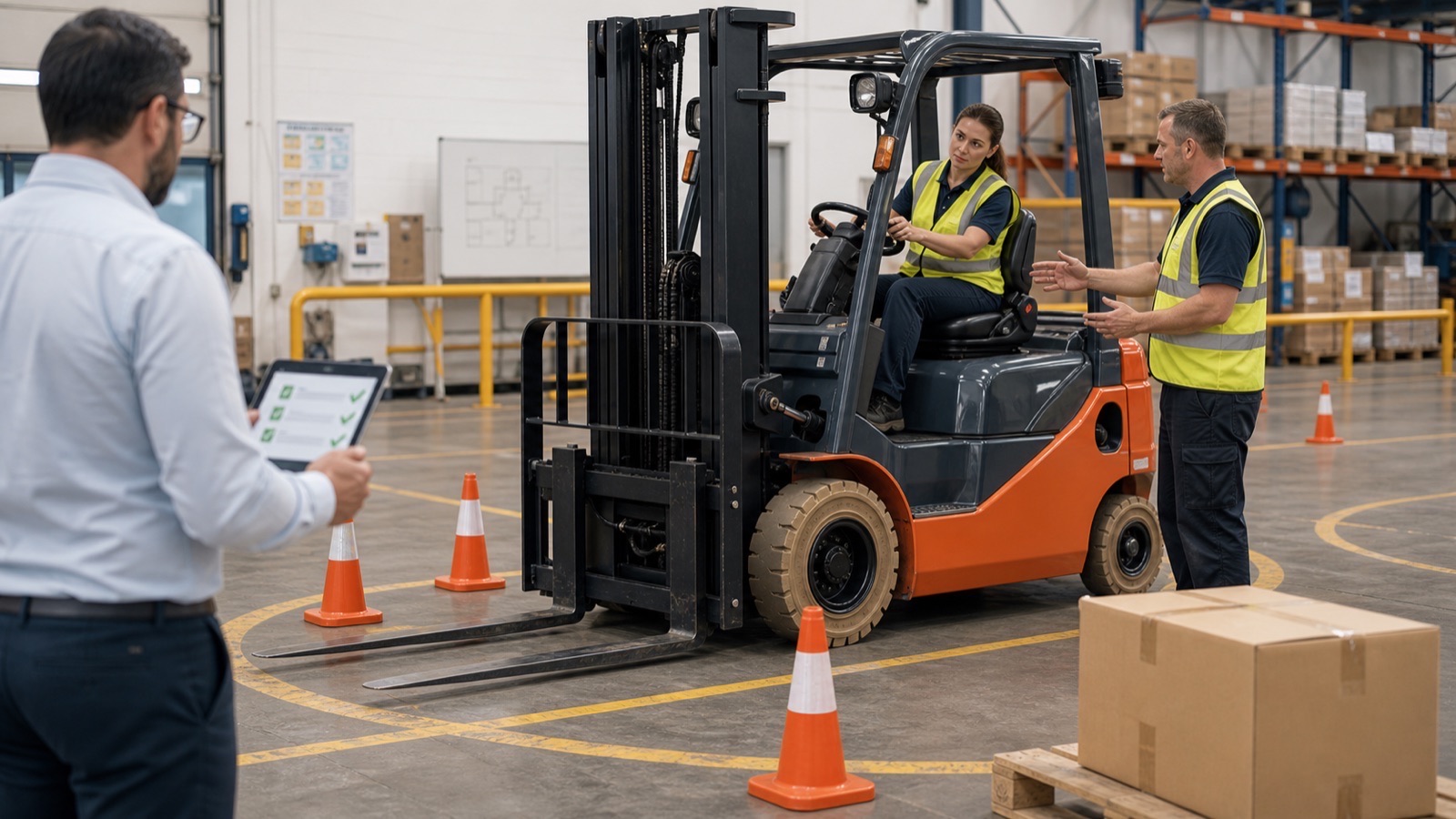
Two forklifts can share a capacity and category while demanding different muscle memory. Direction may be selected by a column lever, fingertip switch, pedal or joystick. Hydraulic functions may be arranged as individual levers or integrated controls, and braking behaviour can differ. When operators move between trucks without structured familiarisation, hesitation and wrong-control inputs can become damage events.
Short answer
Mixed forklift control layouts create risk when an operator's automatic response on one truck produces a different action on another. Managers should map material control differences, decide which require documented familiarisation or reassessment, and prevent unfamiliar trucks being treated as interchangeable simply because the certificates cover the same broad category.
What this means in practice
A multi-brand logistics fleet uses two reach trucks on picking and a hired replacement during maintenance. The site trucks select direction with a hand control; the hire truck uses a different selector position and has more aggressive regenerative braking. During a dispatch peak, an authorised operator reaches for the familiar control, hesitates near a rack end and over-corrects the steering. The contact is minor, but the event proves that category competence alone did not prepare the operator for that control transition under pressure.
The manager decision is not automatically to standardise every truck. Specialist applications, availability and capital constraints may justify variation. The decision is where differences are material enough to require an authorisation step and whether the ongoing error cost makes future standardisation commercially sensible.
Start with a control-layout matrix. List each truck or control family against direction selection, accelerator and brake behaviour, parking brake, hydraulic levers, horn, emergency isolation, display warnings, attachment controls and any programmable modes. Highlight differences that could cause immediate movement, load change or delayed stopping if the wrong control is used.
Key checks
- Group trucks by actual control family rather than make, capacity or visual similarity.
- Record direction, braking, parking and hydraulic-control differences that change immediate truck response.
- Check operator authorisation against each material control family and attachment combination.
- Review incidents, hesitation and near contacts after hire, replacement or fleet-transfer events.
- Provide a low-pressure practical route before the operator enters production or dispatch work.
- Give supervisors a visible way to confirm familiarisation before allocating a different truck.
Familiarisation should be practical and proportionate. An experienced operator may need a focused briefing and demonstration on a modest control difference, while a change in truck category, operating method or attachment can require conversion training or reassessment. The record should state what changed and what the operator demonstrated, rather than relying on a signature that says the handbook was available.
Temporary trucks deserve the same discipline. Breakdowns and peaks create pressure to put a replacement straight to work, precisely when managers are least likely to compare controls. Include the expected control layout in the hire request where possible and make delivery acceptance trigger a competence check before keys are issued.
Damage patterns can show where muscle memory is failing. Wrong-direction starts, abrupt braking, repeated fork-height corrections or attachment movement at the wrong moment should be mapped to the truck transition involved. A pattern that appears only when operators move from one control family to another supports a different intervention from a fault that follows one operator across every truck.
Standardisation has commercial value when it reduces familiarisation time, operator allocation constraints, wrong-control events and parts or maintenance complexity. It also has limits: selecting a less suitable truck simply to keep controls consistent can weaken the operation. Managers should compare the quantified transition cost with the performance benefit of the specialist or mixed equipment.
Supervisors need clear authority when the planned truck is unavailable. The safest answer may be to reallocate an already familiar operator, delay the task, provide a controlled familiarisation session or change the workload. Quietly assuming that a competent counterbalance operator can immediately use any counterbalance truck removes the management decision that the control difference requires.
Review familiarisation after the first live shifts. An operator may demonstrate the controls correctly in an empty area yet struggle when scanning loads, pedestrians and dispatch instructions at the same time. A short follow-up observation can reveal hesitation before it becomes normal or produces repeat contact.
Common mistakes
The most common mistake is using the certificate category as the entire authorisation decision. Another is briefing only the unusual display functions while ignoring direction selection or braking feel that affects the first metre of movement. Finally, informal peer demonstrations can pass on workarounds without producing reliable evidence of what the operator understood and demonstrated.
What good looks like
The fleet has a current control-family matrix, operator authorisations show relevant familiarisation, and replacement trucks cannot enter live work until material differences are checked. Supervisors can explain why an operator was allocated to a particular truck, and follow-up observations test performance under real workload. Managers use transition incidents and familiarisation time when deciding whether the next sourcing decision should preserve a specialist difference or move towards standardisation.
When to ask WRMH for help
Ask WRMH when new, hired or replacement trucks introduce control differences, operators report hesitation, or damage clusters after people change between models. WRMH can compare the equipment, advise whether familiarisation, conversion or refresher training fits the change and support a fleet review of standardisation options. That gives managers stronger competence evidence, safer allocation and clearer cost control without assuming every mixed-fleet difference requires the same response.
Helpful next step: place the two trucks operators switch between most often side by side and record every control that produces a different immediate response.